The superOETHB/WETH pool will receive incentives, but will not have Pool Booster enabled. Incentives added to this pool will increase volume, which improves the superOETHb AMO, which will increase the superOETHb distributed yield. Origin plans to enable Pool Booster for the following Token1 pools, all on the OP Superchain Base chain:
| Token1 | Token2 |
|--------|--------|
| cbBTC | superOETHB |
| cbETH | superOETHB |
| ezETH | superOETHB |
| msETH | superOETHB |
| rETH | superOETHB |
| rsETH | superOETHB |
| USDC | superOETHB |
| USDT0 | superOETHB |
Origin Protocol is asking for $6k per pair to cover 3 epochs. Origin plans to start incentives on Curve, but can also use Aerodrome or Hydrex if the efficiency multiplier is higher. To enable Pool Booster on Aerodrome or Hydrex, these DEXs must first enable superOETHb as a "Connector Token".
Phases 0-4 will happen in 2 concurring groups, starting with the first group at the passing of this grant proposal.
### Phase 0: Deployment (~10 days)
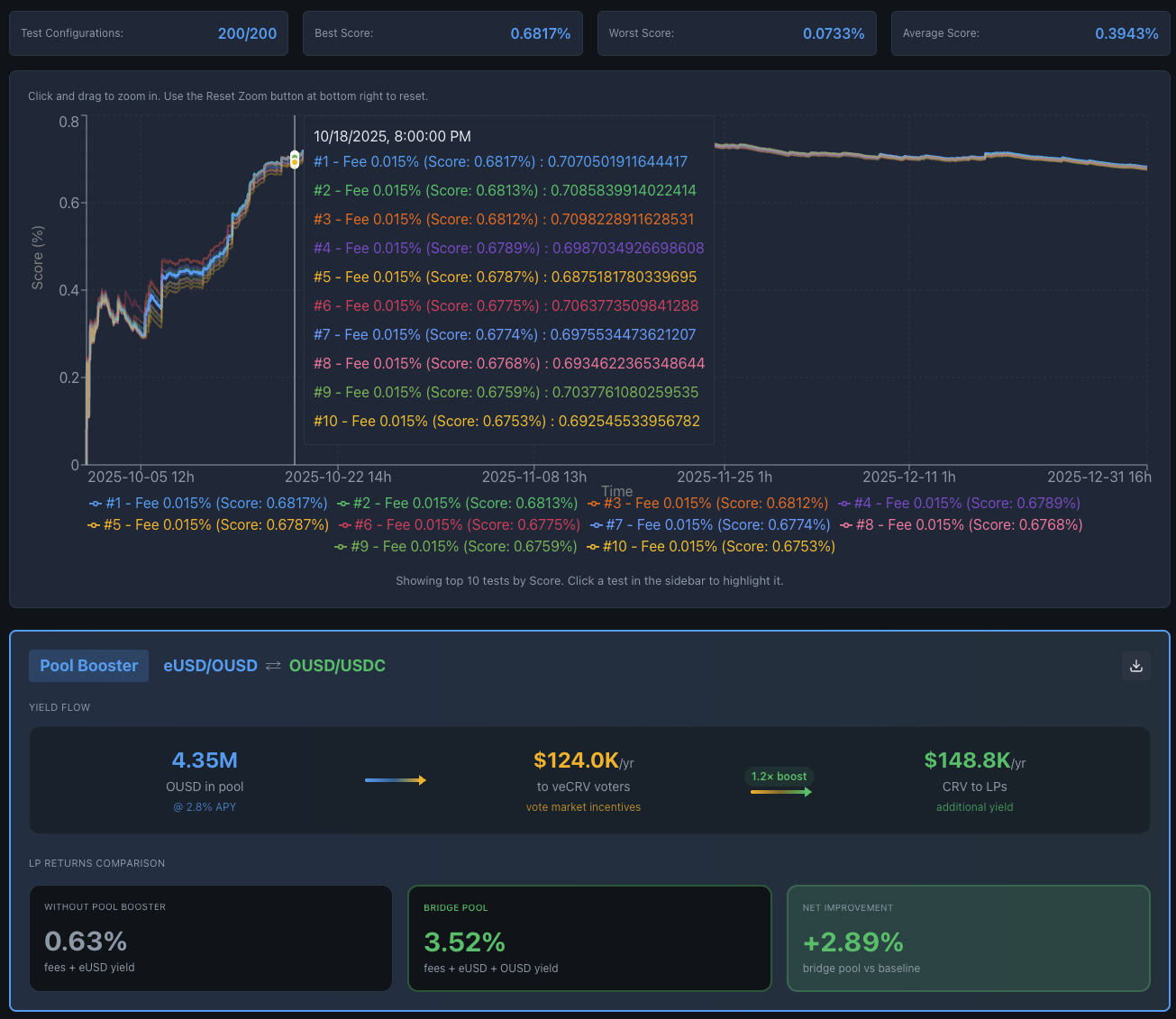
Origin will work with each partner to determine the best parameters for each pool, and can assist with parameter selection using our sophisticated internal simulation tool, which backtests onchain data with newly created pools to ensure they capture trading volume. Here is a screenshot from one of the simulations that we ran on January 16th for eUSD/OUSD that tested 22,034 trades:
Origin will then deploy the pool, initiate the gauge vote, and prepare everything for Phase 1. Once the pools are ready, Phase 1 will start at the beginning of the next epoch.
### Phase 1: Bootstrapping (~14 days, epoch 1)
This is when we put incentives on the pool to attract votes to our gauge. Votes in the gauge will direct CRV emissions. We normally see the ROI on Curve incentives to be around 1.1-2x in CRV, but effiency can be higher on Aerodrome or Hydrex.
Origin would help plug the pool with auto-compounders and other integrations with DeFi protocols that are already using DEXs as a source of yield.
### Phase 2: Emissions (~14 days, epoch 2)
Beyond trading volume, the pool begins generating yield from DEX emissions. This is when capital flows in.
The pool now has some healthy liquidity. Yield forwarding automatically redirects every dollar generated by superOETHb to the pool's voters. As TVL grows, redirected yield grows proportionally, keeping pool APR high without requiring additional spending from the partner token issuer or Origin Protocol.
### Phase 3: Self-Sustaining (~28 days, epoch 3)
The pool becomes fully self-sufficient. Liquidity providers deposit to earn emissions funded by superOETHb yield. Each deposit adds more superOETHb, which generates more yield, creating a self-reinforcing cycle.
### Phase 4: Institutional Depth
Once the pool reaches $10M+ in TVL through its own yield, it provides the depth needed for institutional swaps with minimal slippage. Users will continue to trade between LST/LRTs, BTC, and stablecoins, driving additional volume and fees. Meanwhile, some liquidity providers will stay in the pool to earn the emissions generated by superOETHb.